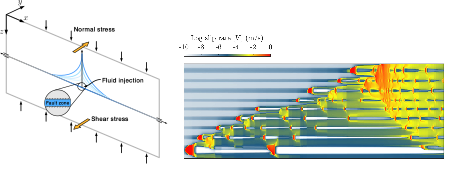
We focus on unravelling the mechanics behind earthquake generation and propagation. By developing and applying advanced numerical models, we simulate the nucleation, growth, and arrest of seismic ruptures, shedding light on the factors that control earthquake size and speed. Our research combines simulation data with theoretical principles of fracture mechanics to improve predictive models, ultimately enhancing our understanding of seismic hazards.
 Friction and Fracture
Friction and fracture are key processes driving failure in rocks and other brittle materials. In our lab, we develop advanced numerical methods such as cohesive-element and phase-field models to simulate fracture initiation and propagation. By integrating numerical simulations with theoretical approaches, we gain deeper insights into the mechanics of material failure, contributing to fields ranging from earthquake science to materials engineering.

Machine Learning for geomechanics
Geo-mechanics has traditionally relied on simplified models to describe material behaviour, but recent advancements in machine learning offer new possibilities. In our work, we apply machine learning techniques like physics-informed neural networks to model the complexities of geo-mechanical systems. This allows us to derive accurate dynamic models from data, advancing material science and improving our ability to predict geo-mechanical behaviour under varying conditions.
CO2 sequestration and geothermal systems
In carbon capture and storage (CCS), CO2 is captured and injected deep underground into geological formations like saline aquifers for long-term storage. While CCS could be crucial in reducing carbon emissions from fossil fuel use, challenges remain in estimating storage capacity and safe injection rates. Our research addresses these issues by developing models based on the fluid dynamics of CO2 injection, migration, and trapping. These models provide more accurate estimates of how much CO2 can be safely injected and stored in geological reservoirs.
Coupled flow-geomechanics and induced seismicity
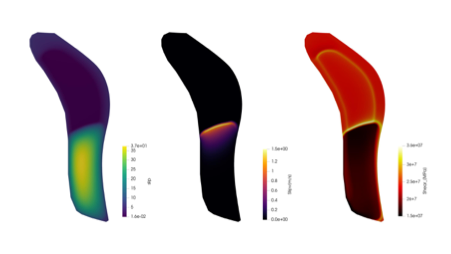
The interaction between fluid flow and geomechanical deformation is critical in many areas of reservoir engineering. In stress-sensitive or faulted reservoirs, understanding the coupling of flow and deformation is essential for predicting how oil, gas, or fluid injections affect reservoir behavior. We have developed innovative algorithms for coupling flow and geomechanics, implementing them into unique models that simulate reservoir deformation and induced seismicity in fractured and faulted reservoirs. These tools are vital for improving predictions of subsurface behavior during resource extraction or fluid injection.
 Geodynamics and seismic processes across the scales
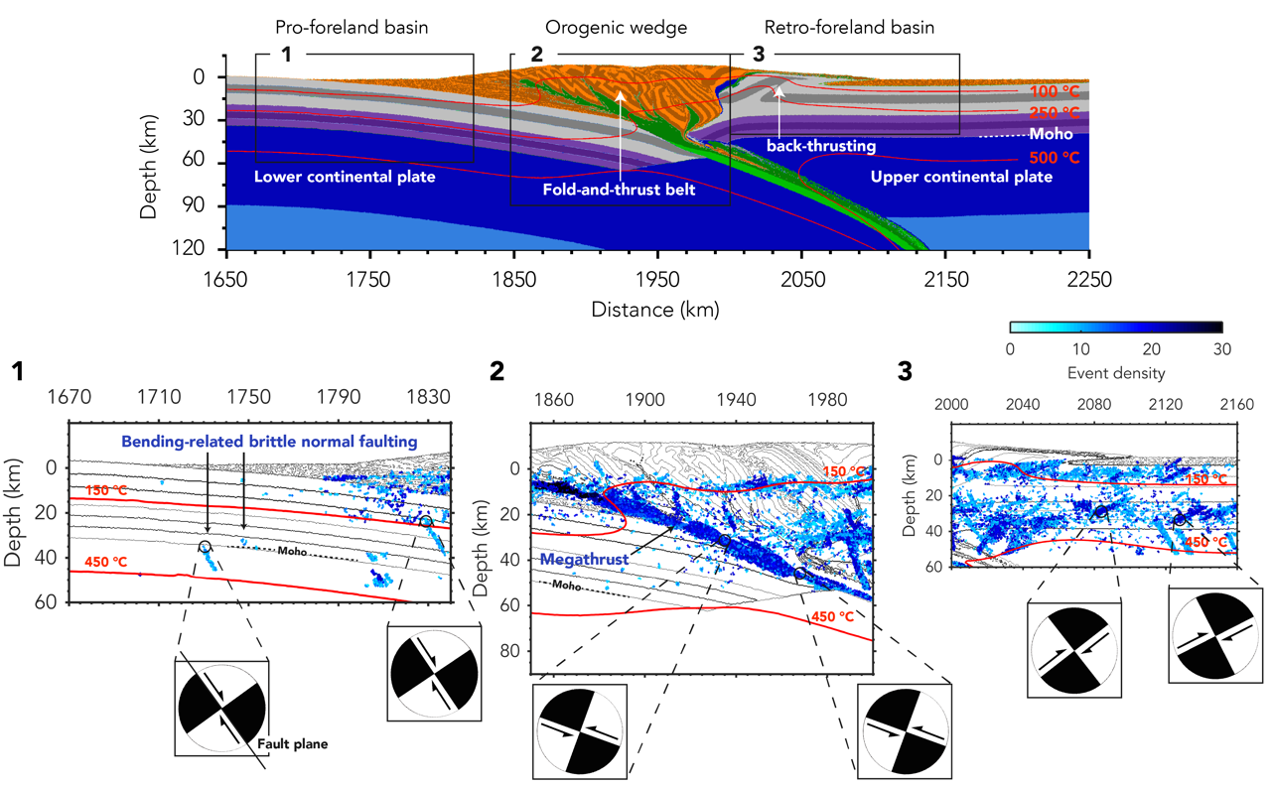
Our work on tectonic processes focuses on developing models that integrate long-term tectonic deformation with the short-term dynamics of seismic cycles. Using cross-scale thermomechanical models, we explore how stress builds, releases, and restores across different time scales. We also investigate how surface processes, such as erosion, interact with tectonic forces to shape the Earth’s topography, providing insights into the complex interplay between surface and subsurface processes in regions undergoing mountain-building and plate collisions.